How to Check Google Rankings: 8 Handy Tools

Key Takeaways
- Moving your content to the first place on Google can increase your click-through rate tenfold, emphasizing the significance of monitoring and improving your Google rankings.
- Ranking high on Google results is vital as half of all clicks go to the top search result, indicating the importance of aiming for the number one spot to drive organic traffic.
- Checking your position in search engine results aids in refining your SEO strategy to attract more leads and align your content with your target audience's search intent.
Editor’s Note: This article was updated in June 2026 to reflect current tools, pricing, and the impact of AI overviews on search visibility.
Your Google rankings determine how much organic traffic your website gets. But if you’re not tracking them consistently, you’re making decisions based on guesswork.
At HigherVisibility, we’ve managed SEO campaigns for hundreds of businesses since 2009, from small local companies to Fortune 1000 brands. One pattern shows up again and again: the businesses that monitor their rankings closely and act on what they find are the ones that grow. The ones that “set it and forget it” lose ground, often without realizing it until the damage is significant.
This guide covers why ranking data matters, how to check your Google rankings using the right methods, the best tools available in 2026, and what to do with the data once you have it.
Why You Should Check Your Google Rankings
Your position on Google’s search results page has a direct, measurable impact on how many people visit your site. The top three organic results consistently capture the majority of all clicks, and moving from the bottom of page one to the top can multiply your traffic several times over. Once you slip to page two, click-through rates drop to near zero for most queries.
According to Advanced Web Ranking’s CTR Tracker, the #1 organic result earns an average CTR of 9%, while position #10 drops to just 0.63%.
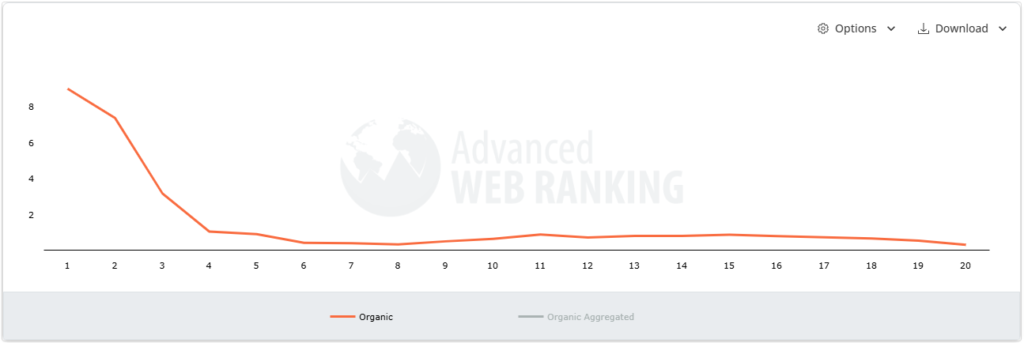
AI overviews have fundamentally changed the click distribution landscape. Google’s AI-generated summaries now appear above traditional organic results for a growing percentage of queries. That means even if you rank number one organically, your actual click-through rate may be lower than it was in 2023 or 2024 because an AI overview is answering the query before users scroll down to your listing.
At HigherVisibility, we’ve observed this shift across our client campaigns firsthand. Pages that maintained stable rankings saw organic click-through rates decline by noticeable margins on queries where AI overviews appeared. This doesn’t mean rankings don’t matter. It means they’re one piece of a more complex visibility picture, and you need to track them alongside other signals.
Rankings Drive Revenue, Not Just Traffic
If your site ranks well for keywords that your potential customers actually search, those rankings translate directly into leads and sales. SEO isn’t just about traffic volume. It’s about attracting the right visitors at the right stage of their buying journey.
Consider what happens when you don’t track rankings:
- You miss early warning signs of algorithm updates affecting your site
- You lose ground to competitors who quietly overtake you on high-value keywords
- You overlook content decay until traffic drops become severe
- You can’t measure whether your SEO strategy is actually working
How Often Should You Check
We recommend different monitoring frequencies depending on your situation:
- Weekly for your top 20–30 revenue-driving keywords. These deserve close attention because a drop from position three to position six on a high-volume term can cost you significant traffic.
- Biweekly for your broader keyword portfolio (50–200 keywords). This gives you trend data without creating noise from daily fluctuations.
- Monthly for a comprehensive audit of your full keyword landscape, including new keyword opportunities and competitive shifts.
The key is consistency. Checking once every few months tells you almost nothing useful because you can’t distinguish a temporary fluctuation from a genuine trend. SEO is worth the investment, but only if you’re measuring what’s happening and adjusting accordingly.
How To Check Your Google Rankings
Before you pick a tool, it helps to understand the three main approaches to checking your Google rankings, and why some are far more reliable than others.
Manual Google Searches
The simplest approach is to type your target keyword into Google and look for your site in the results. It’s also the least reliable.
Google personalizes search results based on your location, search history, logged-in accounts, and device type. The results you see are not the same results your customers see. You might think you rank number three for a keyword when your actual average position is number eight.
If you do search manually, use an incognito or private browsing window, and don’t rely on the results as accurate data. They’re a rough indicator at best.
Google Search Console
Google Search Console is a free tool directly from Google, and it’s the most reliable source of first-party ranking data available. It shows you:
- The actual queries people use to find your site
- Your average position for each query
- Impressions (how often your site appeared in results)
- Click-through rates
The data comes straight from Google, so there’s no sampling error or estimation involved. The main limitation is that Search Console only shows data for your own site. You can’t see where competitors rank, and the data has a 24-48 hour delay.
For any serious SEO effort, Search Console should be your baseline. Every other tool supplements it, but none replaces it.
Third-Party Rank Tracking Tools
For ongoing, automated rank tracking (especially across multiple keywords, locations, and competitors), third-party tools are essential. These platforms check your rankings daily or on-demand, track historical trends, and let you compare your performance against competitors.
At HigherVisibility, our team uses a combination of tools depending on the client’s needs and budget. For a quick, no-cost check, we point clients to our own free rank checker. For full campaign management, we rely on enterprise-grade platforms that track thousands of keywords with granular location and device segmentation.
Best Tools To Check Google Rankings
Not all rank tracking tools serve the same purpose. Some are built for quick, one-off checks. Others are full SEO platforms with rank tracking as one feature among many. A few are purpose-built for large-scale, enterprise-level monitoring.
Here’s how we categorize the tools we use and recommend at HigherVisibility, organized by use case.
Free Tools for Quick Checks
HigherVisibility Free Rank Checker
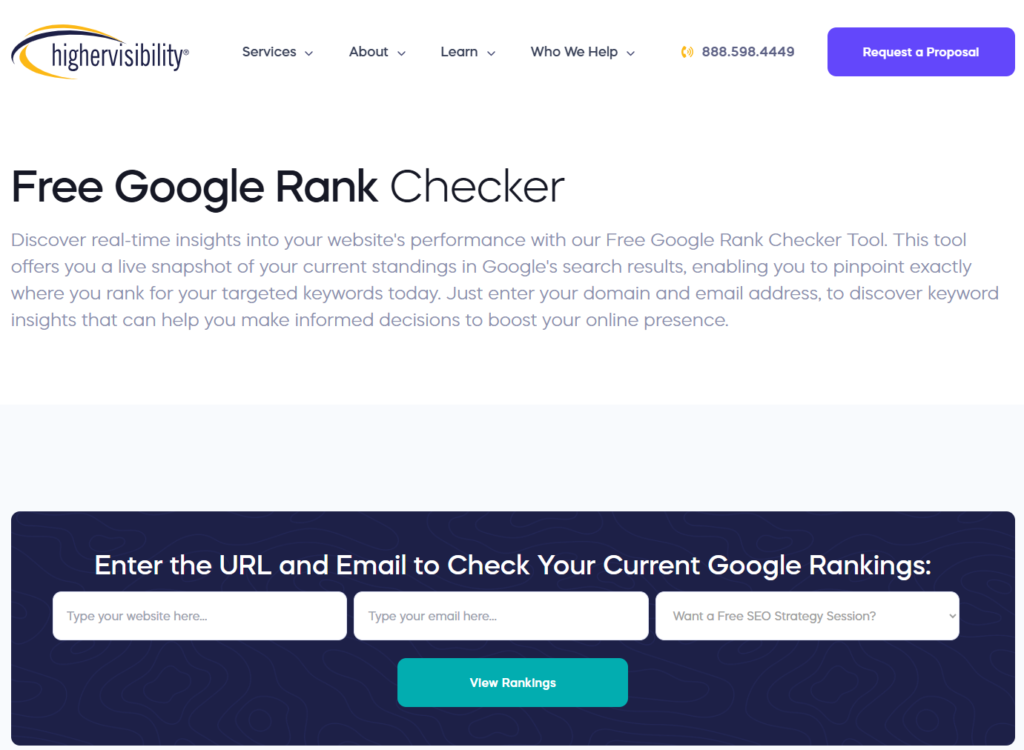
Best for: Getting a fast, accurate snapshot of your keyword positions without creating an account or paying anything.
HigherVisibility’s Keyword Rankings Report tool lets you enter your domain and target keywords to see exactly where you rank on Google. The report includes your current position, the URL that ranks for each keyword, and the search volume for those terms.
Our team built this tool because we wanted to give business owners a straightforward way to answer the question “where do I rank?” without needing to sign up for a platform or navigate a complicated dashboard. It’s the same starting point we use when onboarding new clients: pull a quick rankings snapshot, identify the biggest opportunities, and build a strategy from there.
Use it when you need a fast check on your most important keywords. For ongoing daily tracking across hundreds of keywords, pair it with one of the comprehensive platforms below.
Google Search Console
Best for: Free, first-party ranking data directly from Google.
As covered above, Search Console is indispensable. It won’t give you competitor data or daily automated tracking, but for understanding how Google sees your site, nothing is more accurate. The Performance report is where you’ll spend most of your time, filtering by query, page, country, and device to understand your ranking landscape.
Our agency treats Search Console as the source of truth. When a third-party tool and Search Console disagree on a ranking, we trust Search Console.
Comprehensive SEO Platforms
These tools offer rank tracking as part of a broader SEO toolkit that includes keyword research, site audits, backlink analysis, and competitive intelligence. If you’re managing SEO seriously, you’ll likely want at least one of these.
Semrush
Best for: All-in-one SEO management with strong competitive analysis.
Semrush is one of the most widely used SEO platforms, and for good reason. Its Position Tracking tool lets you monitor daily rankings across desktop and mobile, segmented by location. The competitive positioning maps show you exactly where you stand relative to competitors on your target keywords.
What our team values most about Semrush is the integration between rank tracking and other SEO workflows. You can go from identifying a ranking drop to diagnosing the issue (content gap, lost backlinks, technical SEO problem) without switching tools. The Keyword Magic Tool and competitor analysis features are particularly strong.
Plans start around $130/month for the base tier, with higher tiers available for agencies and larger teams.
Ahrefs
Best for: Backlink-focused SEO teams who also need reliable rank tracking.
Ahrefs built its reputation on one of the most comprehensive backlink indexes available, and its Rank Tracker has matured into a strong standalone feature. You get scheduled ranking reports, SERP feature tracking (including featured snippets and AI overviews), and visibility metrics that show your overall search presence beyond individual keyword positions.
We frequently use Ahrefs for link building campaigns where we need to correlate new backlinks with ranking improvements. The ability to overlay ranking changes against your backlink acquisition timeline is something few other tools do as cleanly.
Pricing varies by plan, with the entry-level tier starting around $130/month.
Moz Pro
Best for: Teams that value domain authority metrics and straightforward reporting.
Moz is one of the original SEO toolsets, and its Rank Tracker offers weekly ranking updates with historical tracking. Moz’s Domain Authority metric remains one of the most widely referenced third-party authority scores in the industry, and its integration with rank tracking data helps you understand the relationship between your site’s authority and its ranking performance.
Moz tends to be more accessible for teams that are newer to SEO. The interface is clean, the learning curve is gentle, and the keyword suggestions feature helps you discover new opportunities alongside your tracking. Plans start around $50/month for the Starter tier.
Enterprise and Specialized Rank Trackers
If you’re tracking thousands of keywords across multiple locations, need API access, or manage rankings for a large portfolio of sites, these tools are built for scale.
SE Ranking
Best for: Cost-effective rank tracking at scale with flexible pricing.
SE Ranking offers one of the better value propositions in the rank tracking space. You can track rankings daily across Google, Bing, and Yahoo, with location-level granularity down to specific cities. The platform also includes site audits, backlink monitoring, and a keyword research tool.
What sets SE Ranking apart is its pricing model, which scales based on the number of keywords you track and how frequently you check them. If you need to track 500 keywords with weekly updates rather than daily, you’ll pay significantly less than you would on Semrush or Ahrefs for equivalent keyword volume. Plans start around $65/month.
AccuRanker
Best for: Dedicated, high-speed rank tracking for agencies and large sites.
AccuRanker is a purpose-built rank tracker (not a full SEO suite), and it’s one of the fastest in the industry. Rankings update on-demand, and you can refresh your entire keyword portfolio in minutes rather than waiting for a daily crawl cycle.
Our team uses AccuRanker when we need near-real-time ranking data, particularly during algorithm updates or right after pushing major site changes. The ability to check “where are we right now?” rather than relying on yesterday’s data is valuable when you’re making time-sensitive SEO decisions. Pricing starts around $130/month for 1,000 keywords.
SERPWatcher by Mangools
Best for: Beginners and small businesses who want simple, affordable rank tracking.
SERPWatcher is part of the Mangools suite and offers a streamlined rank tracking experience without the complexity of enterprise platforms. It tracks daily rankings, provides a Performance Index that estimates your organic traffic based on positions, and sends email alerts when significant ranking changes occur.
It’s a solid choice if you’re tracking a smaller set of keywords (under 200) and want clear, visual reports without spending time learning a complex platform. Plans for the full Mangools suite start around $30/month, making it one of the most affordable options available.
Quick Comparison
| Tool | Best For | Price Range | Rank Update Frequency |
|---|---|---|---|
| HV Rank Checker | Free quick checks | Free | On-demand |
| Google Search Console | First-party data | Free | 24-48 hr delay |
| Semrush | All-in-one SEO | From ~$130/mo | Daily |
| Ahrefs | Backlink + rankings | From ~$130/mo | Daily to weekly |
| Moz Pro | Beginner-friendly | From ~$50/mo | Weekly |
| SE Ranking | Value at scale | From ~$65/mo | Daily to weekly |
| AccuRanker | Speed and agencies | From ~$130/mo | On-demand |
| SERPWatcher | Simple and affordable | From ~$30/mo | Daily |
What To Do After You Check Your Rankings
Knowing where you rank is only useful if you act on the data. Here’s the framework we use at HigherVisibility to turn ranking data into a concrete action plan.
Interpret Your Data Correctly
First, avoid overreacting to single-day fluctuations. Rankings shift daily based on algorithm micro-updates, competitor activity, and Google’s testing. Look at trends over two to four weeks, not day-to-day changes.
Focus on these signals:
- Consistent upward or downward trends across multiple keywords in the same topic cluster. If five related keywords are all declining, that’s a content quality or authority signal, not random noise.
- Position volatility on high-value keywords. If your money keyword bounces between position four and position 12 regularly, that tells you Google isn’t confident about where your page belongs. The content likely needs strengthening.
- SERP feature changes. Did an AI overview appear on a query where you previously received strong organic clicks? Did you lose a featured snippet? These changes matter as much as raw position data.
Quick Wins for Pages Ranking Four to 10
Pages ranking on the bottom half of page one are your biggest opportunity for fast improvement. Google already considers these pages relevant. They just need a push to reach the top three, where the majority of clicks happen.
Prioritize these actions:
- Strengthen your title tags and meta descriptions to improve click-through rates. A better CTR sends positive engagement signals to Google.
- Update the content with fresh data, expanded sections, and better answers to the searcher’s actual question.
- Improve internal linking by pointing relevant pages on your site to these near-top-ranking URLs. Strong internal linking helps Google understand which pages you consider most important.
- Evaluate the featured snippet opportunity. If a snippet appears for the query, format your content to compete for it (concise answer paragraphs, structured lists, clear definitions).
Strengthen Content for Positions 11-20
Pages ranking on page two are in striking distance of page one but need more substantial work. These pages typically need:
- Content depth improvements. Compare your page against the top-ranking competitors. Are they covering subtopics you’ve missed? Are their pages more comprehensive?
- Backlink acquisition. Pages on page two often lack the authority signals to compete with page-one results. A targeted link building campaign can make the difference.
- Search intent alignment. Sometimes a page ranks on page two because it partially matches the intent but doesn’t fully satisfy what the searcher wants. Review the top results and adjust your content format, depth, or angle to better match.
Consider AI Visibility Alongside Traditional Rankings
Traditional rankings still drive the majority of organic traffic, but AI visibility now drives a measurable share of search interactions, and that share is growing. Google’s AI overviews, ChatGPT search, Perplexity, and other AI-powered search experiences are pulling answers from web content and citing sources.
If your content is being cited in AI-generated answers, you’re reaching users even when they don’t click through to your site. If it’s not being cited, you may be invisible in a growing share of search interactions.
At HigherVisibility, we help clients address this through our Generative Engine Optimization (GEO) services, which focus on optimizing content for visibility in AI-powered search experiences alongside traditional rankings.
Frequently Asked Questions
How Do I Check My Google Ranking for Free
The fastest free option is HigherVisibility’s Keyword Rankings Report. Enter your domain and target keywords, and you’ll get your current positions instantly, with no account required. For ongoing free monitoring, Google Search Console provides detailed ranking data for every query your site appears for in Google’s search results.
How Often Should I Check My Google Rankings
It depends on the scale and competitiveness of your SEO efforts. For most businesses, we recommend checking your top revenue keywords weekly and running a full keyword portfolio review monthly. If you’re in a highly competitive industry or actively running an SEO campaign, daily tracking on your core terms helps you catch algorithm shifts early. The important thing is consistency. Sporadic checking doesn’t give you enough data to identify real trends versus normal fluctuation.
Why Does My Google Ranking Change Every Day
Google’s algorithm processes hundreds of ranking signals and runs continuous updates. Your competitors are also updating their content, building links, and optimizing their pages. On top of that, Google regularly tests different result orderings and SERP features. Minor daily fluctuations (one to three positions) are normal and shouldn’t concern you. Sustained movement over two or more weeks, especially across multiple related keywords, is the signal worth investigating.
Can I Check My Google Ranking Without a Tool
You can search for your keywords in an incognito browser window, but this method is unreliable. Google personalizes results based on location, device, and other factors, so what you see may not reflect your actual average ranking. For accurate data, use Google Search Console (free) or a rank tracking tool.
What Is a Good Google Ranking Position
Positions one through three capture the vast majority of organic clicks. Ranking in the top 10 (page one) is generally the minimum threshold for receiving meaningful organic traffic. That said, “good” depends on the keyword. Ranking number seven for a keyword with 50,000 monthly searches may deliver more traffic than ranking number one for a keyword with 500 searches. Focus on the keywords that align with your business goals and have realistic competition levels for your site’s current authority.
How Do AI Overviews Affect Google Rankings
AI overviews appear above traditional organic results for an increasing number of queries. When they do, they can reduce click-through rates for organic results below them, even for the number-one position. Your actual ranking position doesn’t change, but the traffic you receive from that position may decrease. This makes it important to track not just your rankings but also your click-through rates and total organic traffic over time. If you’re seeing rankings hold steady but traffic decline, AI overviews could be the cause. Optimizing for AI visibility alongside traditional SEO is becoming a necessary part of a complete search strategy.
Start Tracking Your Rankings Today
Your Google rankings tell you exactly where you stand in the search results. The real value comes from what you do with that information. Start with a free check using HigherVisibility’s Rank Checker to see where your site stands right now. Set up regular monitoring so you’re never caught off guard by ranking changes. And when you’re ready to turn ranking data into a growth plan, our SEO team can help you prioritize the opportunities that will have the biggest impact on your traffic and revenue.
Request a Proposal and see how HigherVisibility can help you improve your search visibility.

Discover the exact keywords that you are currently ranking for on Google. Our free tool reveals your site's keyword rankings in just 60 seconds.
From Our Insite Blog
We believe that SEO requires an all-encompassing approach to ensure a sustainable future for your site and achieve your goal…. conversions.

I have been working with this company for several months. I have seen an immediate impact to my business. They’re very professional and I love working with them!