How to Optimize Your Content for Google AI Overviews in 2026

Optimizing for AI Overviews means structuring content so Google’s AI can extract, cite, and display your information in the AI-generated summaries that now appear above traditional search results. This requires answer-first formatting, strong EEAT signals, schema markup, and technical optimization.
AI Overviews appear in a significant portion of searches and cite multiple sources, creating new visibility opportunities beyond traditional rankings. Being cited in these AI-generated summaries builds authority, drives qualified traffic from users seeking deeper information, and positions your brand as a trusted source. For marketing directors experiencing declining organic traffic, AI overview content optimization represents a critical shift in how search visibility works.
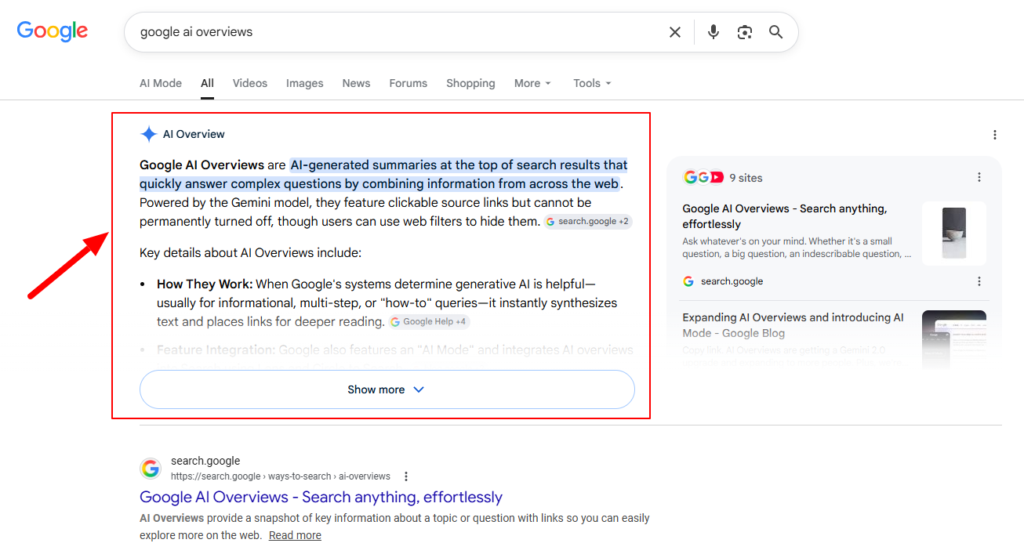
What Google AI Overviews Mean for Your SEO Strategy
AI Overviews are Google’s AI-generated answer summaries that appear at the top of search results, synthesizing information from multiple web sources with citations. These appear as gray or white boxes displaying synthesized text that combines information from three to five sources, with each cited source including a clickable link.
AI Overviews trigger primarily for informational, how-to, and comparison queries—searches like “how to optimize for AI overviews” or “what is schema markup.” They rarely appear for transactional searches where users want to buy immediately. Unlike featured snippets that pull directly from a single page, AI Overviews synthesize information from multiple authoritative sources and cite several pages simultaneously.
The relationship between AI Overviews and traditional SEO metrics requires new measurement approaches. Users who see your brand cited may return directly to your site later, search for your brand specifically, or convert through other channels. Track both citation frequency and assisted conversions, not just direct clicks. Monitor Search Console for queries with high impressions but moderate click-through rates—this pattern often indicates AI Overview citation where users see your brand but research further before clicking.
Based on our analysis of client accounts, pages cited in AI Overviews typically see significant impression increases even when click-through rates remain stable. This creates brand awareness that converts through other touchpoints.
Content Structure That AI Systems Cite
AI Overviews favor content with answer-first paragraphs, clear modular sections, and self-contained explanations. Place the complete answer in the first 50–70 words of each section before expanding with details. Format H2 and H3 headers as actual user questions rather than topic labels. Write each paragraph so it makes sense independently, allowing Google’s AI to pull specific passages without requiring surrounding context.
Short paragraphs of two to four sentences work best. Break dense information into bullets and present comparisons in tables. Include numbered steps for procedures, bullet points for feature lists, and bold text for key terms used sparingly.
We tested this approach across client sites and found that pages restructured with answer-first paragraphs saw AI Overview citations more quickly than pages with traditional narrative structure.
Before: “There are many factors involved in making content that performs well. You need to think about your audience and what they want to know.”
After: “AI Overview optimization requires three structural elements. First, place direct answers in opening sentences. Second, format headers as user questions. Third, make each paragraph self-contained so it remains clear when extracted independently.”
Technical Requirements for AI Overview Visibility
Technical SEO provides the foundation that allows AI systems to access, parse, and trust your content. Verify pages return HTTP 200 status codes, check robots.txt doesn’t block important content sections, remove noindex tags from target pages, and confirm content appears in HTML source rather than loading through JavaScript after initial crawl.
Core Web Vitals function as trust indicators for AI systems. Poor page experience signals reduce your content’s authority even when information quality is high. Load main content within 2.5 seconds (LCP), respond to user interactions within 100 milliseconds (FID), and maintain visual stability with CLS scores below 0.1.
In our client audits, we consistently find that pages failing Core Web Vitals benchmarks are cited in AI Overviews less frequently than technically healthy pages with similar content quality. Understanding how technical SEO differs from other optimization approaches helps clarify why AI Overview success requires this foundation alongside content quality.
One challenge we see frequently: marketing teams optimize content structure but overlook server response times. Even perfectly structured content won’t be cited if pages take 4+ seconds to load or return 503 errors during Google’s crawl attempts.
Schema Markup That Increases Citation Rates
Schema markup provides structured data that helps AI systems understand your content’s meaning and context. Implement Article schema with headline, datePublished, dateModified, author credentials, and featured images. Add FAQPage schema for question-answer pairs—one of the highest-impact schema types for AI citation. Use HowTo schema for step-by-step instructions with clear sequential steps. Include VideoObject schema for embedded videos with name, description, thumbnailUrl, uploadDate, and duration properties.
You can implement multiple schema types on the same page when appropriate. A comprehensive guide might include Article schema for the overall page, FAQPage schema for question-answer sections, and VideoObject schema for embedded content.
We recommend validating all schema through Google’s Rich Results Test before deployment. Invalid schema markup can trigger warnings that reduce your page’s perceived quality, while properly implemented schema creates clear extraction pathways for AI systems.
Building Authority Signals for AI Selection
EEAT—Experience, Expertise, Authoritativeness, Trustworthiness—forms Google’s quality framework that AI systems use to filter sources. AI Overviews strongly favor content with clear EEAT signals to avoid misinformation.
Create detailed author bio pages showing professional background and relevant accomplishments. Implement author schema markup including jobTitle and worksFor properties. Display relevant certifications, industry awards, and published research. Publish original research, proprietary data, and first-hand case studies that position your content as a primary source.
HigherVisibility publishes quarterly SEO performance benchmarks based on our client portfolio, analyzing trends across hundreds of campaigns in different industries. Our recognition as SEO Agency of the Year by Search Engine Land strengthens the authority signals our content carries. This primary-source authority makes our content more likely to be cited in AI Overviews for queries about SEO performance expectations and industry standards.
Backlinks from trusted domains signal to AI systems that your content is reliable and worth citing. Focus link-building efforts on sites that Google’s AI already cites in AI Overviews for queries in your industry. Contribute expert quotes to journalist requests, publish original research that others cite, and create linkable assets such as free tools or comprehensive guides.
A realistic timeline: building sufficient EEAT signals to compete for AI Overview citations in competitive spaces typically takes 6-12 months of consistent effort. Quick wins come from adding proper author credentials and schema markup, but sustained citation success requires ongoing original content publication and authority link acquisition.
Tracking AI Overview Performance
Traditional rank tracking doesn’t capture AI Overview visibility because citations don’t correspond to specific ranking positions. Advanced rank tracking tools now flag which queries trigger AI Overviews and whether your pages are cited. Track 20–30 priority queries weekly to identify citation patterns.
Use Search Console to infer performance through strategic data analysis. Export data for target queries, filter for those with high impressions but lower-than-expected clicks based on your average position, then manually search these queries to check for AI Overview presence. Document which pages are cited and their position within citations.
Build a consolidated dashboard tracking AI Overview status, citation frequency, impression and CTR trends, competitor citations, and month-over-month growth in AI visibility. Update weekly for priority content and monthly for secondary pages.
Keep in mind that AI Overview appearance varies by user location, search history, and device type. What you see when checking manually may differ from what your target audience sees. We recommend checking from multiple locations and logged-out browsers to get representative samples.
Partner With AI Overview Optimization Experts
AI Overview optimization requires continuous technical expertise, content strategy, and performance monitoring that most in-house teams struggle to maintain alongside other responsibilities. The specialized knowledge needed—schema markup implementation, EEAT signal optimization, AI citation pattern analysis—typically exceeds what generalist marketers can master while managing multiple marketing channels.
HigherVisibility’s Targeted Growth System includes AI Overview optimization as part of our comprehensive SEO approach, combining technical expertise with data-driven content strategy to increase your visibility in AI-powered search. Our teams monitor AI Overview developments continuously, implement schema markup correctly, and adjust strategies quarterly based on your performance data and competitive landscape changes. Since 2009, we’ve adapted our methodologies to every major algorithm shift, including this transition to AI-powered search results.
Request a proposal from HigherVisibility to learn how we can optimize your content for AI Overviews and drive measurable growth through increased citations, authority building, and qualified traffic from Google’s AI-powered search features.

- What Google AI Overviews Mean for Your SEO Strategy
- Content Structure That AI Systems Cite
- Technical Requirements for AI Overview Visibility
- Schema Markup That Increases Citation Rates
- Building Authority Signals for AI Selection
- Tracking AI Overview Performance
- Partner With AI Overview Optimization Experts

Enter your email to get strategic insights, a plan of action, and pricing options.
From Our Insite Blog
We believe that SEO requires an all-encompassing approach to ensure a sustainable future for your site and achieve your goal…. conversions.

Can't recommend them enough! I had a great experience with them and saw results but made the mistake of thinking a cheaper agency was better. Boy was I wrong. I'm back now!