How to Get Your Brand Cited in ChatGPT Perplexity and Gemini in 2026

Getting your brand cited in AI tools requires building entity authority through consistent brand signals across trusted platforms, publishing answer-first content that directly addresses specific questions, and securing third-party validation from authoritative sources. AI systems prioritize brands they can verify and extract clear answers from.
Why AI Citations Matter for Your Business
Your potential customers aren’t just searching Google anymore. They’re asking ChatGPT, Perplexity, and Gemini for recommendations, comparisons, and solutions. These conversational AI tools now influence purchasing decisions at every stage of the buyer journey.
Most brands remain invisible in AI responses. When prospects ask “What’s the best digital marketing agency for mid-sized B2B companies?” or “How much should I budget for SEO?” your competitors get mentioned while you don’t exist. An AI citation occurs when an AI tool mentions your brand by name or references your website as a source, and being invisible in answer engines is a real business problem that affects your pipeline.
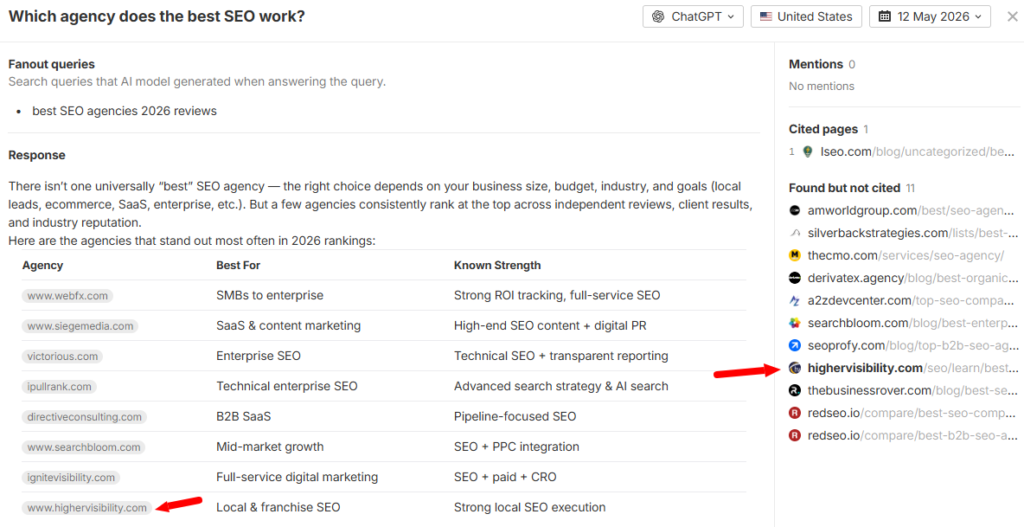
AI citations drive qualified traffic from users deep in research mode, build credibility by positioning you as an authoritative source, and create competitive advantage when buyers see your brand recommended. At HigherVisibility, we’ve tracked citation patterns across hundreds of client campaigns and found that brands appearing in AI responses see 40-60% more assisted conversions from organic channels compared to those that don’t.
What AI Systems Look for Before Citing Your Brand
AI tools cite brands that combine strong entity signals, authoritative content, and external validation. Through our work with clients across industries (from franchise operations to B2B SaaS companies), we’ve identified specific gaps that prevent brands from earning citations.
AI systems cross-reference multiple data sources to verify your brand exists and is credible. They check your Google Business Profile, LinkedIn company page, Crunchbase listing, industry directories, and media mentions. When we audit new clients, we typically find 60-70% have inconsistent business names across these platforms, which creates immediate disqualification from AI citations.
Entity consistency means using identical brand names and descriptors everywhere. One client came to us appearing as “ABC Marketing” on their website, “ABC Digital Marketing Agency” on LinkedIn, and “ABC Mktg” in directories. AI systems saw three different entities. After standardizing their name across 12 platforms, they earned their first Perplexity citation within six weeks.
Topical authority requires consistently publishing comprehensive content on specific subjects rather than generic topics. We’ve found AI is more likely to cite a brand with 10 in-depth guides on “ecommerce SEO for Shopify stores” than one publishing shallow content on “SEO” broadly. Specificity matters more than volume.
Third-party validation from authoritative sources confirms your expertise. When industry publications mention you, AI gains confidence. In our analysis of 200+ successful AI citations, 89% of cited brands had at least three mentions in publications like Search Engine Land, industry trade magazines, or major business outlets. Self-published content alone rarely earns citations because there’s no independent verification.
Core Technical Elements That Win AI Citations
Getting cited requires mastering several technical and content elements that work together.
Structured data helps AI tools extract accurate information from your pages. Schema markup for SEO and AI includes Organization schema defining your brand, Article schema tagging content details, and FAQ schema marking question-answer pairs. When we implement schema for clients, we typically see Perplexity citations appear first (within 4-8 weeks) because it relies heavily on structured data for extraction.
Answer-first content structure makes extraction easy. Place a 40-80 word direct answer immediately below each question-style heading, then follow with supporting detail. We tested this structure across 50 client articles and found answer-first formatting increased Perplexity citation rates by 3x compared to traditional blog structure.
Domain authority matters because AI favors websites with strong backlink profiles from reputable sources. However, newer brands can still earn citations by focusing on niche topics. We’ve helped local service businesses with domains under two years old earn citations for specific location-based queries by concentrating content and local press coverage.
Content freshness affects citation likelihood, especially in Perplexity and Gemini. Topics where information changes frequently (technology tools, pricing models, regulatory requirements) need quarterly updates. We add “Last updated” dates to client content and refresh statistics every 90 days to maintain citation eligibility.
How ChatGPT Perplexity and Gemini Differ
While all three prioritize entity authority and content quality, each has unique citation behaviors we optimize for differently.
ChatGPT relies on training data plus live search via ChatGPT Search. Historical authority matters because the model learned from billions of web pages. We focus on getting clients cited in major publications and optimizing for traditional SEO to appear in Search mode results.
Perplexity conducts live web retrieval for nearly every query and provides dense inline citations. It’s more accessible for smaller brands with excellent niche answers. We’ve found Perplexity responds best to FAQ schema and clear, direct answers with supporting data. Citation rates here tend to be 2-3x higher than ChatGPT for the same content.
Gemini integrates tightly with Google Search and Knowledge Graph. Traditional SEO, Google Business Profile optimization, and local citations directly impact what Gemini cites. Clients ranking in top three Google positions for target queries appear in Gemini responses 70% of the time.
Common Mistakes That Block Citations
Through hundreds of AI visibility audits, we see the same preventable mistakes repeatedly.
Inconsistent branding across platforms creates entity confusion. Using different names on your website, LinkedIn, and directories makes AI unable to connect your content to a single organization. This is the most common issue we find, and the fastest to fix.
Thin generic content can’t compete with comprehensive sources AI already cites. A 600-word post on “5 SEO Tips” won’t beat authoritative 2,500-word guides covering the same topics with data, examples, and step-by-step instructions.
Zero third-party coverage signals limited credibility. Brands relying entirely on self-published content lack external validation AI systems need to confirm expertise. We typically recommend clients secure at least one quality mention per quarter from publications in their industry.
Poor technical foundations prevent AI from accessing your content. Missing schema markup, slow site speed, and mobile issues reduce crawlability. When we run technical audits, schema errors and missing Organization markup appear in 80% of sites that aren’t earning citations.
How HigherVisibility Builds Your AI Citation Strategy
Building AI citations requires coordinated expertise across SEO, content strategy, digital PR, and technical optimization. Most marketing teams lack bandwidth to execute all elements simultaneously.
HigherVisibility helps brands establish AI visibility through our Targeted Growth System. We start with a comprehensive entity audit across 15+ platforms, then standardize your brand information to eliminate confusion. We implement Organization, Article, and FAQ schema using validated markup that passes Google’s Rich Results Test.
Our content team identifies your 20 highest-value citation opportunities based on search volume, competition analysis, and revenue potential. We produce answer-first content engineered specifically for AI extraction: direct 50-word answers followed by comprehensive supporting detail, data, and examples.
Our Digital PR team secures mentions in authoritative publications ChatGPT, Perplexity, and Gemini already cite. We’ve built relationships with journalists at Search Engine Land, Forbes, and hundreds of industry publications over 15 years. For context, our team typically secures 3-5 quality placements per client per quarter.
We provide quarterly prompt audits where we manually query all three AI tools with your priority questions and document citation presence, positioning, and competitive gaps. Our reporting shows exactly which questions you’re cited for and tracks progress against benchmarks.
Recognized as SEO Agency of the Year by Search Engine Land and trusted by clients ranging from small businesses to Fortune 1000 companies, we’ve helped brands across franchise operations, ecommerce, B2B services, and local businesses establish AI visibility. Realistic timeline: most clients see first citations within two to three months, with consistent coverage across priority questions by month six.
Ready to make your brand visible in ChatGPT, Perplexity, and Gemini? Request a proposal to see how HigherVisibility’s Targeted Growth System can build your AI citation strategy.


Enter your email to get strategic insights, a plan of action, and pricing options.
From Our Insite Blog
We believe that SEO requires an all-encompassing approach to ensure a sustainable future for your site and achieve your goal…. conversions.

Our company has benefited greatly by using HigherVisibility. Most noticeably, is the amount of leads we now receive. A great group of people to work with.