Google’s AI Content Guide Now Calls Manual Fact-Checking “Critical”

On October 1, Google rewrote its generative AI content guidance with three new sentences. One of them extends a manual fact-checking obligation to title tags, meta descriptions, structured data, and alt text: the surfaces most businesses auto-generate at scale.
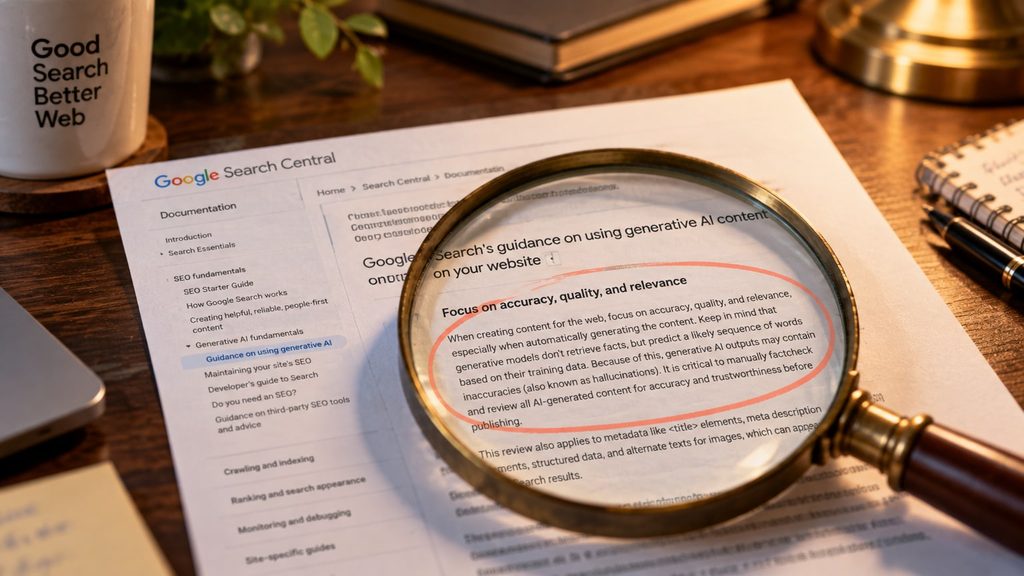
Google added three sentences to its official guidance on AI-generated content this week and rewrote a fourth, and two of them have drawn nearly all the coverage.
On October 1, Google updated “Google Search’s guidance on using generative AI content on your website”, a document that had not changed since October 2025. The addition that made the news: “It is critical to manually factcheck and review all AI-generated content for accuracy and trustworthiness before publishing.” Google rarely uses the word “critical” in Search documentation, and the timing, one week into the September 2026 spam update, did not go unnoticed.
The sentence immediately after it rewrote the scope of the rule. Where the old document said the accuracy advice includes metadata, the new one says the fact-checking review applies to metadata: title elements, meta descriptions, structured data, and image alt text. That is the part of the page most ecommerce catalogs, programmatic SEO builds, and agency content pipelines generate automatically, often without a human ever reading the output.
What changed on October 1
- Google’s AI content guidance changed on October 1, 2026, for the first time in a year. Verified against the archived version, the entire edit sits in one paragraph: three sentences added, one rewritten.
- The headline addition calls manual fact-checking of AI content “critical.” The overlooked addition extends that obligation to <title> elements, meta descriptions, structured data, and image alt text.
- The change landed on day eight of the September 2026 spam update, the first rollout Google has estimated at “up to two weeks,” versus under three days for each of the year’s first three spam updates. A Google Research paper on detecting coordinated AI content at scale surfaced the same week.
- Nothing in the change bans AI content or announces a new penalty. Treat it as the written standard Google will point to, and audit your four metadata surfaces this week.
The diff
We pulled the archived version of the document (captured January 1, 2026, identical to the May 2025 text) and compared it line by line against the version published after the October 1 revision. Everything outside one paragraph under the heading “Focus on accuracy, quality, and relevance” is unchanged. The paragraph ran two sentences before the revision and five after: three added, one rewritten.
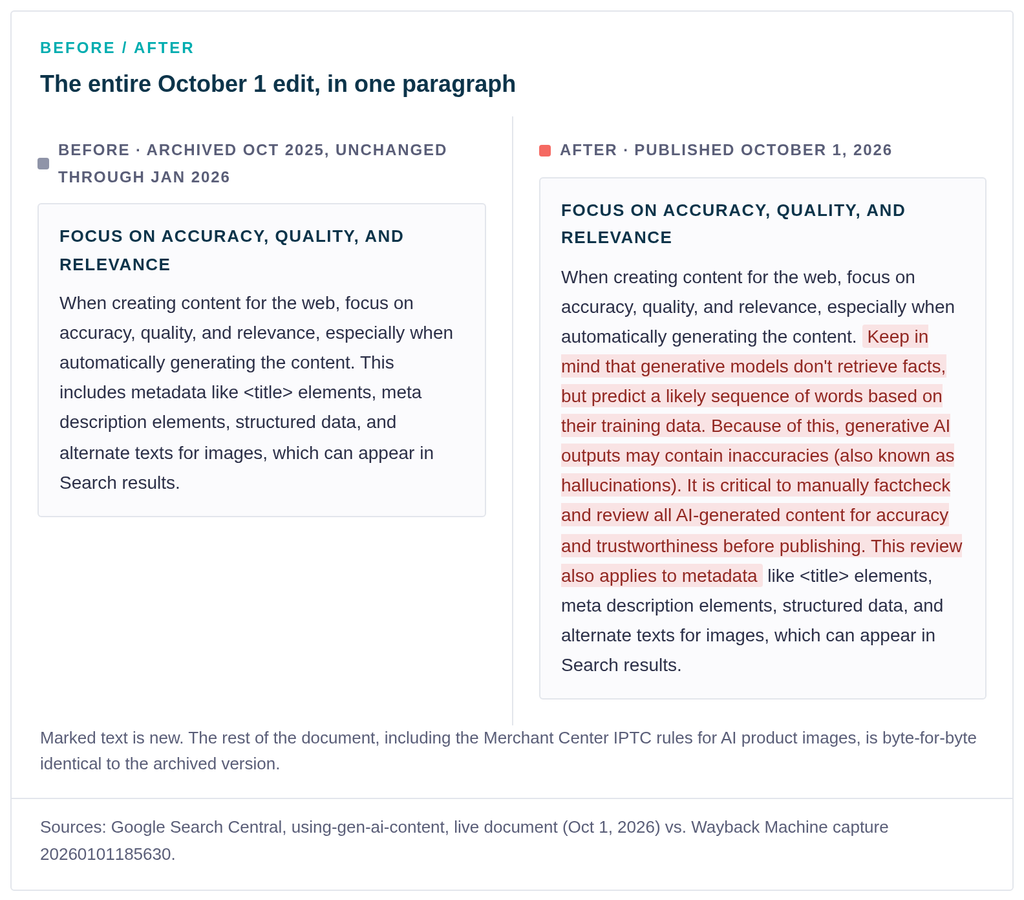
Three distinct moves sit inside that marked block:
The guidance now explains the mechanism. Google now tells publishers why the rule exists: “generative models don’t retrieve facts, but predict a likely sequence of words based on their training data.” That is the first time the guidance itself explains hallucinations rather than merely warning about accuracy in the abstract.
An obligation with the strongest word in Google’s documentation vocabulary. The old text asked publishers to “focus on accuracy,” which reads as a suggestion. The new text says manual fact-checking of all AI-generated content is “critical,” and it specifies when: before publishing. Barry Schwartz of Search Engine Roundtable, who broke the change, noted that “Google doesn’t often use the word ‘critical’ in its Google Search help documentation,” and asked the obvious follow-up: “It makes you wonder if Google’s September 2026 spam update is going after these things.”
The scope extends to metadata. The old sentence folded metadata into the general accuracy advice (“This includes metadata like…”). The new sentence attaches metadata to the fact-checking duty (“This review also applies to metadata like…”). In practice: if a pipeline writes your titles, descriptions, schema, or alt text and nobody reads them, the document now says that the site is skipping a step Google calls critical.
The reason Google gave, and the word it chose
Google logged the change in its documentation updates feed on October 1 with a bureaucratic explanation: “Updated the using generative AI content guide with information from the Search Quality Raters guidelines. Why: To get our documentation in sync with our presentations we use at our developer events.”
It may be housekeeping. It also says something more: Google has been rehearsing this phrasing on stage before writing it into policy, which means the “critical” wording is a deliberate, reviewed choice rather than a copyedit. Guidance documents are where Google writes down the standard it later cites when systems or manual reviewers look at a site. The guidance does not rank anything by itself, but it defines what “doing AI content right” means at the moment something goes wrong.
The timing: day eight of the longest spam rollout of the year
The guidance changed on October 1. The September 2026 spam update began rolling out on September 24 at 9:15 a.m. PDT. So the new fact-check language landed one week into a spam rollout Google itself describes with an unprecedented duration estimate:
“Released the September 2026 spam update, which applies globally and to all languages. The rollout may take up to two weeks to complete.” Google, Search Status Dashboard, September 24, 2026 (via Search Engine Journal)
The estimate matters because of what came before it. Each of the year’s first three spam updates carried a “few days” window and finished quickly. September is the outlier:
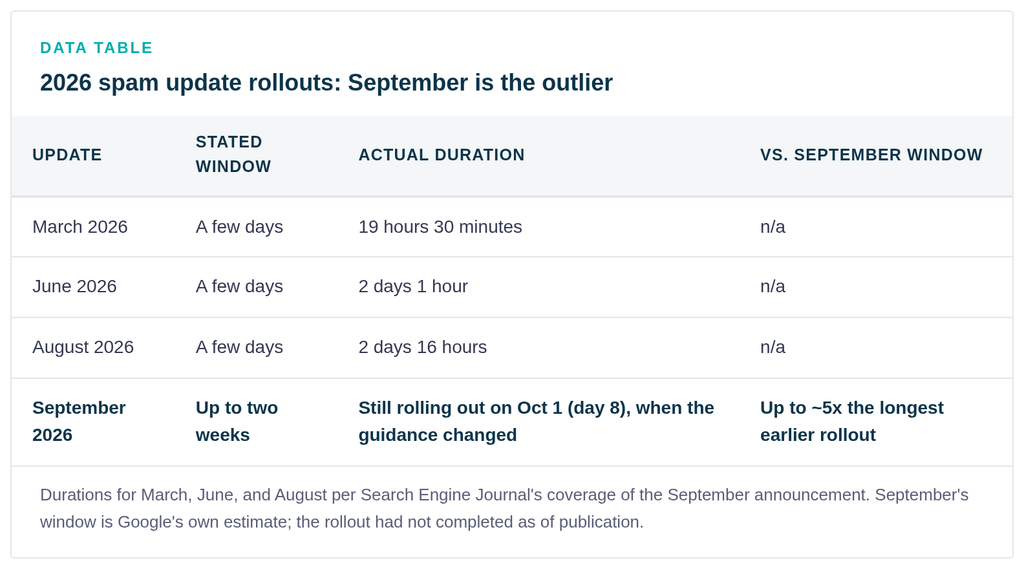
A rollout that takes five times longer than its predecessors is not necessarily five times bigger, but it is a different kind of work: longer rollouts typically mean phased reprocessing rather than a single recalculation. Google has not said what the update targets, which is unusual even by its standards.
One more data point surfaced in practitioner circles the same week. Google Research’s paper “The Synthetic Gap” describes SAFE (Scaled Abuse Forensics Examiner), a multi-agent system built to investigate “AI slop” campaigns at scale: “an automated multi-agent architecture designed for the scalable forensics of adversarial synthetic media.” The system looks less at individual pieces of content than at coordination: clusters of related channels, synchronized publishing patterns, and templated variations of the same generated material. The paper was circulating on r/SEO by October 2.
Place the three events side by side:
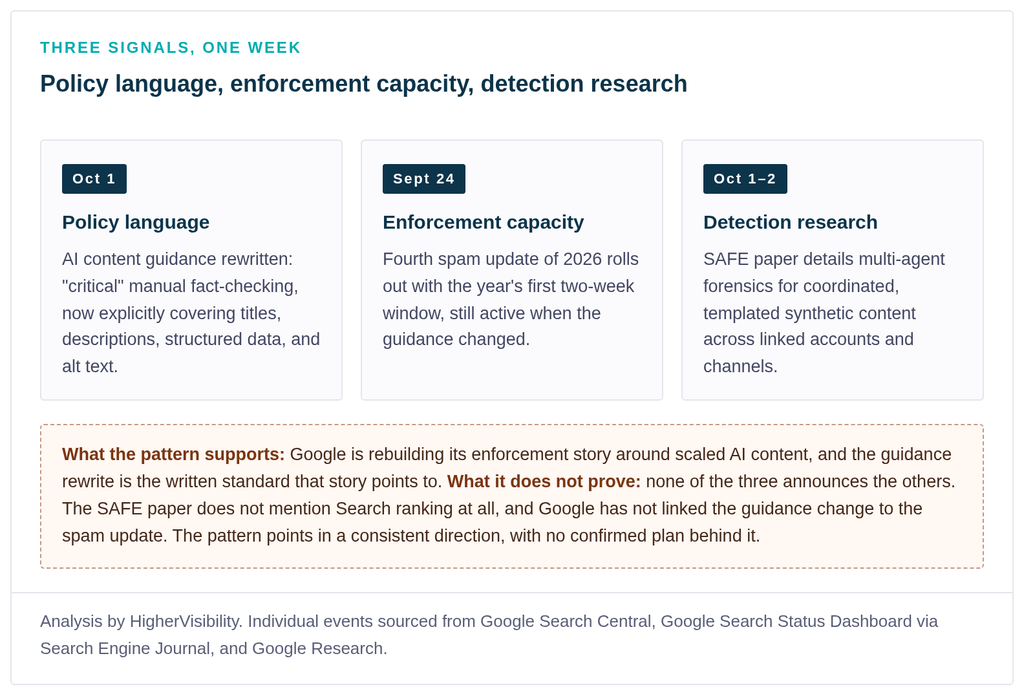
John Mueller’s September 7 statement adds another signal from the same month: Google can “lose faith” in sites that ship low-value programmatic pages, with recovery measured in months or years. Written standard, active rollout, detection research, and a public warning from a Search advocate landed in the same month.
What did not change (and one early report to correct)
Because the coverage has moved fast, a few corrections and clarifications matter:
- AI content is still allowed. The document opens by saying generative AI “can be particularly useful when researching a topic, and to add structure to original content.” What violates policy is unchanged: generating many pages without adding value, under the scaled content abuse rule.
- Documentation changes do not move rankings by themselves, and this update is definitional. It is the standard a reviewer, a rater-informed system, or a spam policy citation can now point to.
- Some early summaries misdated the ecommerce image-labeling rule. They described the Merchant Center requirement, IPTC DigitalSourceType: TrainedAlgorithmicMedia metadata on AI-generated product images, as part of this update. We checked the archived document: that clause is word-for-word identical to the version live since at least May 2025. It did not change. It is, however, still a requirement most AI product-image pipelines ignore, and it now sits directly under the paragraph Google just strengthened.
The audit: what to check on the four named surfaces
If any part of your metadata is generated by template, plugin, or LLM, the guidance now names your workflow specifically.
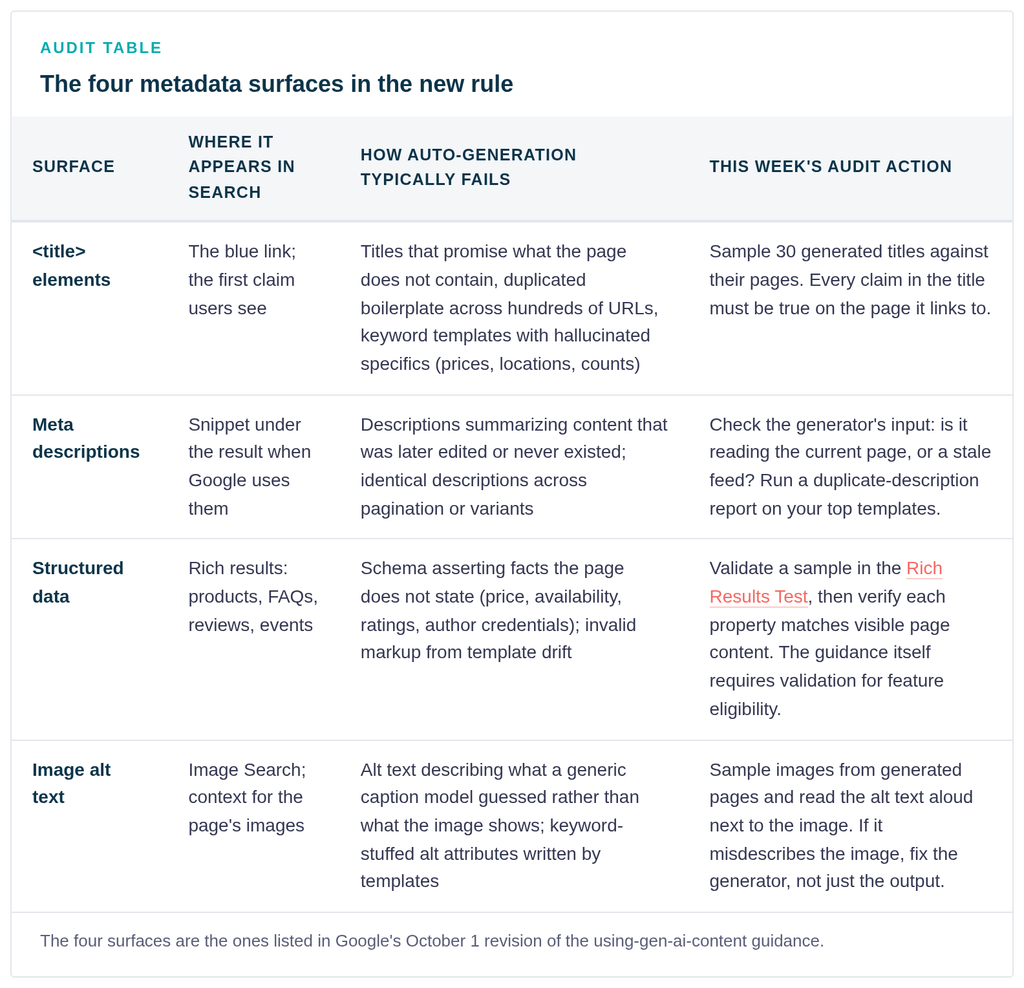
A sequence that works for most sites:
- List every tool, plugin, or script that writes titles, descriptions, schema, or alt text without a human approving the output. Include ecommerce feeds and programmatic templates, the two most common offenders.
- Add a review gate before publishing. The guidance says “before publishing” twice in effect. A post-publication sweep is better than nothing, but it does not match the standard as written.
- Sample-check each output against the published page. The failure mode Google is describing is content that is fluent and wrong. The check is “does this metadata match what is actually on the page,” not “does this read well.”
- For ecommerce images, verify the IPTC label. AI-generated product images must carry the DigitalSourceType: TrainedAlgorithmicMedia metadata per Merchant Center policy, and AI-generated product titles and descriptions must be labeled as AI-generated, under a rule that predates the October update and is widely unimplemented.
- Write the workflow down where a client or an auditor can find it. When a spam question ever gets raised about a site, “here is our review workflow” is a better answer than “the content is good.”
The room is skeptical, and fairly so
Practitioners received the update with the distrust you would expect. The r/SEO thread on the change drew roughly 90 upvotes and 41 comments within a day of posting, and the top comment, at 80 points, was blunt:
“Translation: please, maintain your content quality to a good level so that Gemini can steal accurate data.” Leather-Cod2129, r/SEO, October 2, 2026
The second-most-upvoted response, from hiperkarma, argued Google is “handing over the accountability for facts and truths to everyone but themselves.” Another commenter cited Wired’s fact-checker, who estimated Google’s own AI Overviews are wrong at least 30 percent of the time, with other estimates she referenced running 45 to 60 percent.
The skepticism has a point. The audit above is worth doing even if you believe the guidance is posturing, because hallucinated metadata costs you regardless of Google’s motives: schema that claims what the page does not say loses rich results, titles that misrepresent content lose qualified clicks, and templated errors replicate at the speed of your pipeline.
Common questions
Does this update ban AI-generated content?
No. The same document still says generative AI is useful for research and structure. Google’s policy targets scaled content that adds no value, regardless of how it was produced. What changed is the stated standard of care for AI-assisted content, including its metadata.
Will sites lose rankings for skipping manual fact-checks?
There is no penalty announced in a documentation page, and guidance is not a ranking system. The realistic risk is indirect: metadata that misrepresents pages is exactly the kind of signal quality systems can detect, and the guidance is the standard Google cites when it acts.
My AI tool checks its own output. Is that enough?
The guidance specifies manually fact-checking and review, and it sets the deadline: before publishing. Automated checks catch format errors and occasionally contradictions; they do not catch fluent falsehoods, which is the failure mode Google describes in the new text (“models don’t retrieve facts, but predict a likely sequence of words”). That is why the rule requires a human sampling step.
We publish hundreds of pages a month. Manual review is not realistic at that volume.
If the volume cannot be reviewed, the guidance’s logic says the volume should not ship. Sample-based review plus generator fixes (better inputs, constrained outputs, blocking generation where the model lacks data) is the workable middle, and it matches the “before publishing” requirement in spirit.
Is the September 2026 spam update targeting this?
Google has not said what the update targets, and nobody outside Google can confirm a link. What is on the record: the guidance changed on day eight of the year’s longest spam rollout, in the same month Google published research on detecting coordinated synthetic content and its Search advocates warned about programmatic low-value pages.
Sources
- Google Search’s guidance on using generative AI content on your website, Google Search Central, revised October 1, 2026.
- Archived version of the guidance, Wayback Machine, captured January 1, 2026 (used for the before/after comparison).
- Latest Google Search documentation updates, October 1, 2026 changelog entry.
- Barry Schwartz, “Google Updates AI Content Guidelines: Manually Factcheck & Review AI-Generated Content,” Search Engine Roundtable, October 1, 2026.
- Matt G. Southern, “Google Has Started Rolling Out the September 2026 Spam Update,” Search Engine Journal, September 24, 2026 (rollout start time and prior-update durations).
- Mathur, Jalali, Wang, Kamineni, Chaudhary, Zhao, Liu, “The Synthetic Gap: Automating Forensic Investigation of ‘AI Slop’ with the Scaled Abuse Forensics Examiner (SAFE),” Google Research (PDF).
- r/SEO discussion thread, October 2, 2026 (~90 upvotes, 41 comments at publication).
- Barry Schwartz, “Google Can Lose Faith In Sites,” Search Engine Roundtable, September 7, 2026 (John Mueller on programmatic SEO).

- What changed on October 1
- The diff
- The reason Google gave, and the word it chose
- The timing: day eight of the longest spam rollout of the year
- What did not change (and one early report to correct)
- The audit: what to check on the four named surfaces
- The room is skeptical, and fairly so
- Common questions
- Sources

Enter your email to get strategic insights, a plan of action, and pricing options.
From Our Insite Blog
We believe that SEO requires an all-encompassing approach to ensure a sustainable future for your site and achieve your goal…. conversions.

Nothing is guaranteed in marketing but I'm happy to know that a company like this is not about the bottom dollar - and instead values the ability to deliver results.